

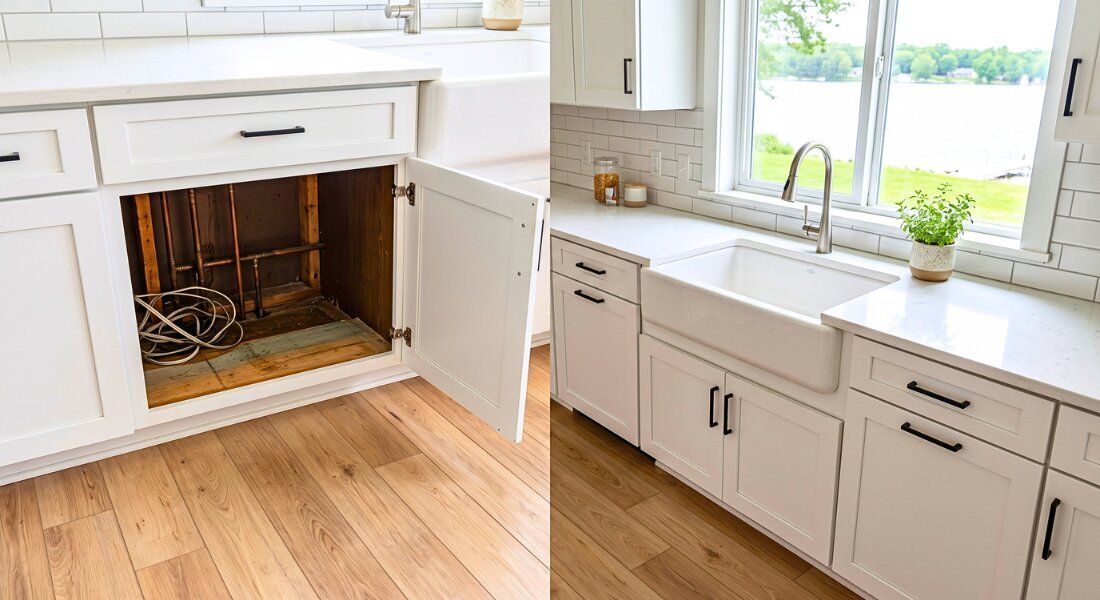
A renovated lake cottage looks clean and appealing on paper, and often it truly is. A new kitchen, updated bathrooms, and modern HVAC go a long way toward reassurance. For many buyers, that combination makes moving forward feel much easier.
While those renovations have value, they don’t tell you what is inside the walls. On older Southwest Michigan lake cottages, that reality can change the math on the entire purchase.
That doesn’t mean people should stay away from these older lake cottages outright. However, buyers need to enter the process informed and know what to look for before closing.
Older Southwest Michigan lake cottages often have histories that cosmetic updates don’t address. Understanding what renovations show, what inspections miss, and what questions to ask can help buyers avoid costly surprises. Before purchasing, buyers should look beyond appearances and understand what they’re really taking ownership of.
What Cosmetic Updates Tell You About a Lake Cottage
Cosmetic updates on a renovated lake cottage tell you a seller invested in what buyers see during showings. That is the honest version worth keeping in mind.
Granite countertops and stainless appliances won’t tell you whether the crawl space floods during heavy rain. They also won’t reveal whether the pipes are prone to freezing in winter months. And they certainly won’t show whether the septic system was originally designed for four months of seasonal use rather than year-round living.
When a water leak turned up in my lake house, we had to open the walls for repairs. Behind the drywall, we found newspaper stuffed around the outlets, dating back to 1932. It quietly passed through two or three ownership transfers without a single disclosure. Not because anyone was hiding anything, but because no one had the chance to look until now.
A cosmetically updated cottage can carry good bones underneath, along with an uninsulated crawl space that’s worth a closer look. It might also have pipes routed through unheated spaces that freeze once temperatures drop below 20 degrees. The septic system may have been sized for four months of occupancy, so it’s worth checking whether it’s ready for full-time, year-round living. Most of these issues are manageable, but buyers should know about them before closing.
None of these items show up in the listings, which is exactly why a closer look matters. Most won’t appear in a seller’s disclosure either, especially when the seller is a flipper.
Michigan’s Seller’s Disclosure Law
In Michigan, buyers in standard residential transactions can rely on the Michigan Seller Disclosure Act to help surface known defects. It’s a legal document, and any misrepresentation on it can carry real consequences for sellers. That said, a disclosure is only as good as what the seller knows.
A seller who bought, renovated, and relisted a property without ever living in it still owes buyers a disclosure statement under Michigan law. But the form only covers what the seller actually knows. An investor who owned the cottage for a few months may honestly know very little about the roof, foundation, septic, or insulation, so the safety net buyers count on can be much thinner than it looks.
That means the responsibility for discovering what’s underneath a fresh coat of paint lands largely on the buyer and their inspector.
Michelle Scott has worked Southwest Michigan lake properties since 1995. She has seen this pattern repeat across markets and price points.
“You never know what you’re going to get when you take that drywall down. And it couldn’t be disclosed because it had gone through two or three different buyers and it was no longer something that was known. Flippers in this area don’t even have to fill out a seller’s disclosure. So you’re taking a chance there, too.” – Michelle Scott, Broker and Owner
What a Standard Inspection Covers on a Lake Cottage
A standard home inspection evaluates what’s visible, accessible, and testable under normal conditions at the time of the visit. It does not evaluate what’s behind walls, underneath furniture, or beneath a finished floor.
For lake properties specifically, standard inspections tend to miss:
- Where water is entering crawl spaces, and its likely source
- Mold behind finished surfaces and beneath flooring
- Structural issues in older cottages, where jacks have gradually leveled wavy floors over the decades
- Well and septic conditions, particularly for systems sized for seasonal use
The American Society of Home Inspectors (ASHI) publishes helpful standard-of-practice guidelines outlining exactly what inspectors are and aren’t required to evaluate. It’s worth a read if you’re planning to buy an older home.
“It looks shiny and new, but lipstick on a pig is still a pig. These lake houses have been around forever. They weren’t put on helicals, so the water affects the structural part of the house, and they’ll jack them up, so the floors go all wavy. Is it a concrete crawl space? Because if it’s dirt, you get water in there, and that’s going to be a problem.” – Michelle Scott, Broker and Owner
That doesn’t mean the standard inspection isn’t valuable. It still provides a ton of useful information on these older cottages. Buyers just need to understand what the standard inspection doesn’t cover and how to fill in those gaps. For more context, we have a post about how to approach lake home inspections in Southwest Michigan.
How to Evaluate a Flipper Renovation Before You Buy
With no seller’s disclosure and limited inspection visibility, a sharp buyer’s agent asking the right questions becomes your best asset.
If you’re evaluating a renovated lake cottage in Southwest Michigan, these are the questions worth slowing down for:
- Who completed the renovation, and when was it finished?
- Is there a seller’s disclosure, and if not, why not?
- Has anyone opened the walls or the crawl space in the last decade?
- What is the septic system sized for, and when was it last pumped and inspected?
- What are the insulation details for the exterior walls and crawl space?
- Has the property been used year-round, or only seasonally?
The competitive nature of some lake markets might cause buyers to consider waiving inspection contingencies. While that can position your offer to win, you need to understand the tradeoffs. Read our post about what to consider before skipping contingencies on a Southwest Michigan lake home.
Common Questions About Renovated Lake Cottages in Southwest Michigan
Do flippers in Michigan have to provide a seller’s disclosure on a renovated lake cottage?
Yes. Michigan’s Seller Disclosure Act covers most residential sales, and a seller who renovated a home without ever living in it is not exempt. The catch is that the disclosure only reflects what the seller knows, and an investor who never lived there may know very little. If a listing doesn’t include a disclosure, ask why before you proceed.
What do standard home inspectors typically miss on lake properties?
Standard inspectors evaluate visible, accessible conditions at the time of the inspection. They do not assess what’s behind finished walls, beneath furniture, or inside crawl spaces with limited access. On lake properties specifically, it helps to know where inspectors sometimes miss things.
How can I find out what insulation a renovated lake cottage actually has?
Ask for renovation documentation: permits, contractor records, or before-and-after photos. If that documentation doesn’t exist, you still have a good option. A thermal imaging inspection can detect temperature variations inside walls that suggest missing or inadequate insulation. For older cottages with no renovation history, budget for the possibility that wall cavities contain minimal insulation or original period materials.
What’s the risk of buying a cottage built for seasonal use if I want to live there year-round?
Their septic systems are typically sized for just four to five months of occupancy each year. Insulation levels in these homes can also struggle to hold heat below a certain temperature threshold. Systems never built for year-round use naturally face more strain when pushed that way. Before closing on a seasonal structure with year-round intentions, a detailed mechanical and septic review is genuinely worth the cost.
Should I get a separate septic inspection on a lake cottage?
Yes. A standard home inspection does not include a septic evaluation. Lake properties commonly have older systems that have never been upgraded, some dating back to original construction. A septic inspection performed by a licensed specialist will identify the system type, estimated capacity, and current condition. For properties near the shoreline, proximity to the water may also affect what upgrades are permitted under Michigan environmental rules.
What is a helical pier and why does it matter for lake cottage foundations?
A helical pier is a type of deep foundation anchor used to stabilize structures on unstable or water-affected soil. Many older lake cottages were not built with helical piers and have settled unevenly over time, with owners periodically using jacks to level the structure. This pattern often shows up as wavy or uneven floors. A structural engineer can assess whether ongoing settling is an active concern or a managed condition.
Are renovated lake cottages ever solid purchases?
Yes. A renovated lake cottage can be a solid purchase when the renovation was thorough, documentation exists, and the price reflects the property’s actual condition. The concern isn’t renovation itself. It’s the gap between what cosmetic updates signal and what the underlying structure actually contains. A fairly priced cottage with honest disclosures and a clean inspection often outweighs a similar property whose walls haven’t been opened in decades.
Know Before You Own What’s Inside the Walls
The best time to find out what’s behind the drywall is before you own it. A fresh kitchen won’t offset a failed septic system or a crawl space that floods every spring. The questions that protect you are the ones you ask before you sign.
If you’re evaluating a renovated lake cottage in Southwest Michigan, you need the full picture. We’d love to help you understand what the listing might not be telling you outright. Start a low-pressure conversation for helpful guidance along the way.
ABOUT THE AUTHOR
Michelle Scott | Multi-Million-Dollar Producer | Owner, Michigan Lakes Real Estate Team Inc. | Licensed Realtor® since 1995 | Waterfront Specialist across 120+ Southwest Michigan lakes | Licensed in Michigan and Indiana