
If you’re shopping for lake property in Southwest Michigan, the South Chain of Lakes demands different homework. It is not a single lake with one set of conditions. It is a connected waterway system linking Magician Lake, Donnell Lake, Pipestone Lake, and several smaller bodies through navigable channels.
That connectivity is the main attraction. You can launch from one lake and spend the day exploring another. But the same connections introduce complications most buyers never consider. Water depths vary from one lake to the next, and channel restrictions can affect what kind of boat you use.
A listing might say “access to the South Chain,” but your day-to-day experience depends on details the listing may not mention. Understanding those connections can make a major difference in choosing the right property.
The Connections Are Not All the Same
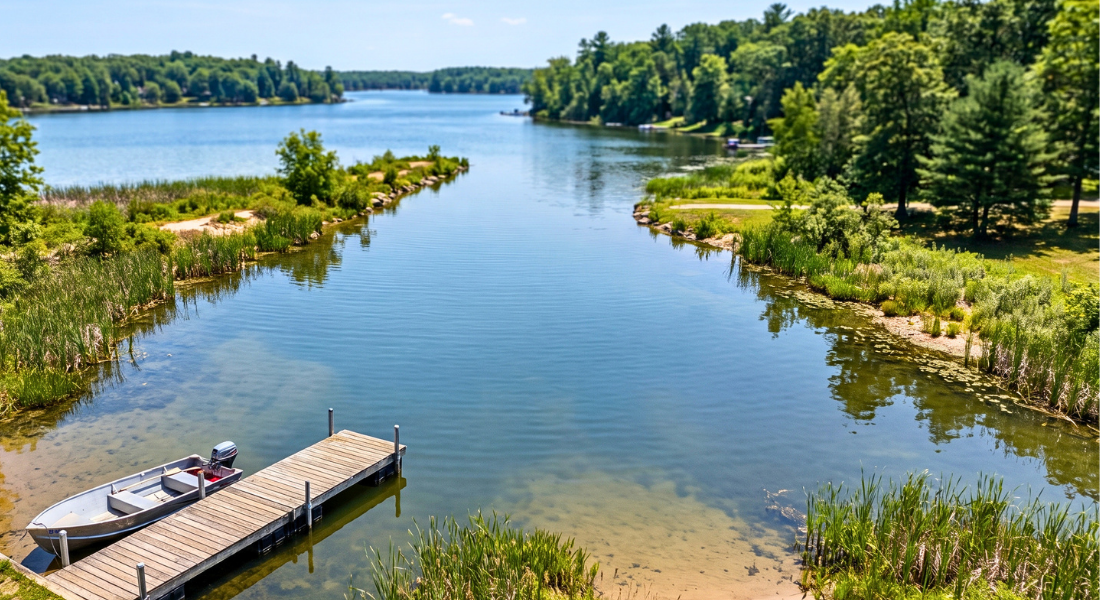
The South Chain of Lakes sits primarily in Cass County. It links several named lakes through natural and improved channels. Magician Lake is the largest and best-known body in the system. Channels connect Magician with Donnell Lake, Pipestone Lake, Dewey Lake, and other nearby waters.
Boaters prize the chain because you can travel between lakes without trailering. But the channels are not uniform. Buyers should pay attention to:
- Channel width and depth: Some routes accommodate larger boats, while others are better suited to kayaks and smaller fishing boats.
- Water conditions: Seasonal water levels can affect how easily you navigate certain channels.
- Boat restrictions: Speed and no-wake rules can limit how you travel between lakes.
- Reliable access: A connection shown on a map may not work equally well for every boat or under every condition.
A map alone will not tell you how each connection works in practice. If boating is your major reason for buying, verify the routes that matter most before making an offer.
Who Controls the Water?
The South Chain does not fall under one township or one set of local rules. Magician Lake spans parts of Volinia Township and Keeler Township. Donnell and Pipestone fall under different local jurisdictions as well.
For buyers, that creates important questions about who manages what. Wake rules, dock permits, and lake association requirements can vary between lakes. Buying on Donnell does not necessarily mean having the same boating experience or rules as Magician.
Before making an offer, determine which township governs your parcel. Then find out which lake association covers the water you use. These are not the same thing, and both can matter.
A property near a channel can add another layer of complexity. The parcel may fall under one jurisdiction while the connected waterway has separate rules or oversight. Sorting this out before closing can prevent costly surprises later.
A Different Waterfront Experience for Every Lake
Depth, bottom conditions, and shoreline characteristics vary across the South Chain’s lakes. Magician Lake has substantial depth in places, with sandy bottom areas. Pipestone Lake is shallower in many areas, while Donnell Lake has its own depth and bottom characteristics.
That difference matters because connectivity does not mean equivalence. Buying on the chain does not give you the experience of every lake. You get the daily experience of the lake where your property sits.
You will spend most of your time on your home lake. Access to another lake can be a valuable bonus, but it does not replace convenient water at your own shoreline. Depth, bottom conditions, and weed growth can affect swimming, docking, and other everyday activities.
Michigan DNR provides depth information for many inland lakes. Review the available maps carefully. Focus on the depth near the property, not just the lake’s maximum depth.
A property with South Chain access can offer a very different experience depending on its home lake and shoreline conditions.
“Chain Access” Can Mean Different Things
Listings in this area use the South Chain label broadly. Some properties have direct lakefront on one of the chain’s primary lakes. Others have deeded access to a smaller body that connects to the larger system.
Those situations can create very different ownership experiences. Deeded access to a connecting lake is not the same as owning direct Magician frontage.
Before assuming chain access means what you expect, ask:
- What type of access is included? Is it direct frontage, deeded access, or shared access?
- How does the shared access work? Is there a shared dock, and how many homes use it?
- Where can you keep your boat? Can you leave a boat in the water, or must you launch each visit?
- How does the access connect to the chain? Is the route suitable for the boat you plan to use?
- Who maintains the access and channel? Determine whether an association, individual owners, or another entity handles maintenance.
Also confirm whether lake association or HOA fees cover channel maintenance or weed treatment. The organization serving your property may maintain your home lake without maintaining the channel you use to reach another lake.
That distinction can determine whether chain access is a practical benefit or simply a listing label.
Common Questions About South Chain Lake Properties
Which lakes are part of the South Chain of Lakes in Michigan?
The South Chain includes Magician Lake, Donnell Lake, Pipestone Lake, Dewey Lake, and several smaller connecting bodies. The lakes are linked by channels that allow boaters to travel between different parts of the system. Buyers should confirm exactly which waterway a listing refers to when it advertises South Chain access.
Can you boat between all the lakes on the South Chain?
You can travel between several major lakes, but not every channel is suitable for every boat. Some connections are narrower or shallower than others. Water levels and seasonal conditions can also affect navigation. Buyers with larger boats should check the specific route from their property before assuming the entire chain is accessible.
Are the South Chain lakes all-sports lakes?
Magician Lake is an all-sports lake where skiing, tubing, and wakeboarding are common. Other lakes may have different practical limitations based on size, depth, or local rules. Buyers should check the specific regulations and boating conditions for the lake where the property is located.
Do all South Chain properties share the same township governance?
No. Properties across the South Chain can fall under different township jurisdictions. Local ordinances and permitting requirements may vary by location. Lake associations can also have their own fees, maintenance responsibilities, and property rules. Confirm which township governs the parcel and which association, if any, covers the property and water access.
Know What You’re Buying
The South Chain offers more complexity than a typical lake property search. Understanding the lake, access, channels, and local requirements can help you avoid surprises.
The Michigan Lakes Team can help you evaluate what “chain access” actually means for a property. Schedule a consultation to discuss your options and get answers to your questions.
ABOUT THE AUTHOR
Michelle Scott | Multi-Million-Dollar Producer | Owner, Michigan Lakes Real Estate Team Inc. | Licensed Realtor® since 1995 | Waterfront Specialist across 120+ Southwest Michigan lakes | Licensed in Michigan and Indiana