

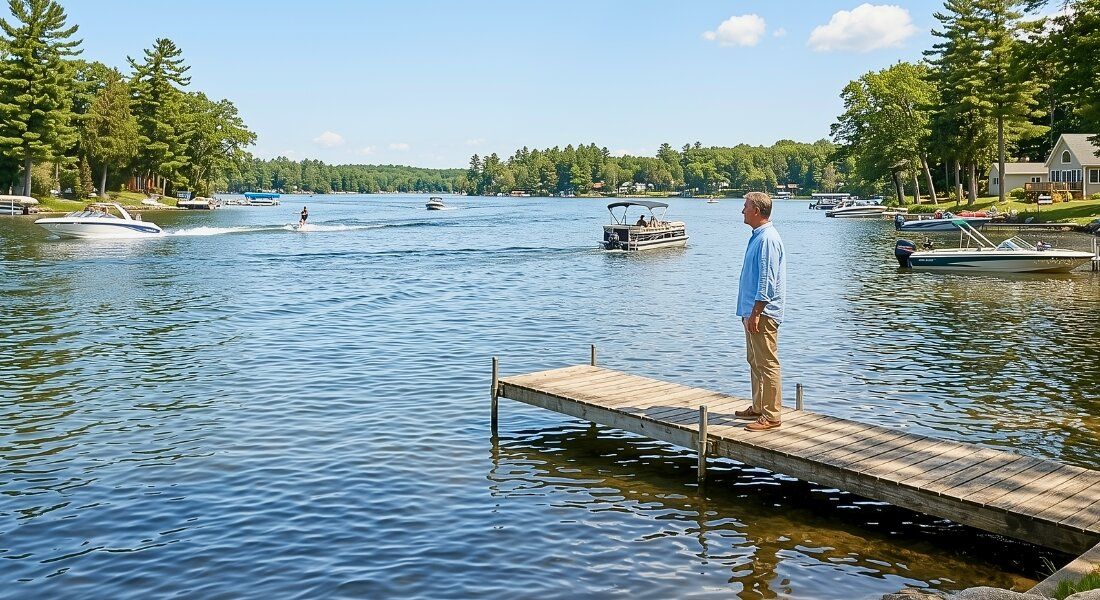
Michigan’s all-sports lake designation tells buyers that motorized watercraft are permitted. It does not tell them what size engine is allowed, when they are permitted, or which township-specific rules apply.
For Chicago-area buyers purchasing lake property in Southwest Michigan, these differences matter. Understanding what you can and can’t do on a lake is a significant factor in finding the right lake home.
The all-sports label is a legal baseline. It opens a category. It does not describe a lake.
Buyers who treat it as a conclusion and filter from there are skipping the questions that actually determine whether a specific lake works for their planned use of the water.
Michigan’s all-sports lake designation means motorized watercraft are permitted on that body of water, but it does not specify engine size limits, operating hours, traffic patterns, or township-specific rules that govern actual use. Buyers filtering by the all-sports classification alone miss critical details like horsepower restrictions, boating hour windows, counterclockwise traffic requirements, and whether a lake is private or has deeded access points that affect congestion and weekend experience. Understanding township ordinances and practical constraints specific to each lake is essential before purchasing waterfront property, as the state designation is only a legal baseline, not a complete picture of how a lake operates.
What Does the All-Sports Lake Designation Mean in Michigan?
Michigan’s all-sports designation is a state-level classification confirming that motorized watercraft are permitted on that body of water. It does not specify engine size, operating hours, traffic direction, or any of the township-level ordinances that govern actual use. The designation is a legal baseline, not a complete picture of how the lake operates day to day.
Township ordinances layer on top of the state classification. They vary depending on which lake or township, and do not appear in any listing. A buyer with a high-powered boat could purchase on an all-sports lake and discover their specific setup creates problems they never anticipated.
Boating hours on most Southwest Michigan lakes run from sunrise to sunset. Counterclockwise traffic patterns are standard and enforced. Michigan’s boating safety requirements apply to anyone operating a motorized vessel.
Horsepower Matters More Than Most Buyers Expect
The state designation says nothing about engine size. But on inland lakes, engine size matters in ways that go well beyond legality.
Southwest Michigan’s largest inland lakes top out at around 1,000 acres. Putting a large, high-powered vessel on a lake that size means tight circles, significant wake, and damage to neighboring properties’ seawalls.
Michelle Scott is a waterfront specialist who has worked in Southwest Michigan lake property for more than two decades. When a buyer leads with high horsepower, the first question she asks is whether they’re running an engine over 250.
“Is it bigger than a 250 engine? I would say that’s better for Lake Michigan than on an inland lake. We do have one on Diamond Lake, a thousand-acre lake. I think he’s got a 350 or 400, but he’s a boat builder, so that’s why he has it. But it’s too big for normal.” – Michelle Scott, Broker and Owner
Even where no formal horsepower restriction exists in a township ordinance, engine size imposes real practical constraints. The Michigan Department of Natural Resources tracks lake classifications and enforces watercraft rules. However, the practical ceiling for inland lake use is set by the water itself as much as by any statute.
What the Listing Doesn’t Capture About Lake Use Rules
No listing captures the full picture of how a lake actually operates. Several conditions can catch buyers who filter for all sports and assume the designation settles their questions.
These include:
- Horsepower considerations
- Operating hour windows
- Counterclockwise traffic requirements
- Boating certification enforcement
All these rules exist at the township level and are enforced on the water.
Beyond the legal framework, there is the practical reality of summer congestion. A lake that felt calm in May looks very different on a Saturday in July. The all-sports designation does not differentiate between those two dates. The experience does.
“There’s always a sheriff on the boat every weekend going around the lake and issuing tickets for people that aren’t doing the right thing. If they’re going the wrong way around the lake, people need to know that. You need a boating license. If you don’t have a boating license, they’re going to give you a ticket, and it’s $200 plus. Hours, water use; those are the things that aren’t included in ‘all sports.'” – Michelle Scott, Broker and Owner
Does Lake Access Type Change the Weekend Experience?
Yes, significantly. And this question rarely surfaces during the search phase.
Some all-sports lakes are private. Others carry deeded access points that allow non-frontage property owners to bring their boats and families to the same water on the same summer Saturday. The all-sports label does not distinguish between the two.
But the weekend experience on a private lake and on a lake with multiple public or deeded access points can be dramatically different. They have different noise levels, congestion, and the amount of open water available during peak season.
A buyer who runs the all-sports filter, schedules a showing in May, and signs in June may not see that lake under real operating conditions. Understanding wake rules and differences in lake classification is one of the most overlooked steps in Southwest Michigan lake purchases.
Not sure whether a specific lake matches how you actually plan to use the water? Talk with the Michigan Lakes Team before you narrow your search.
What to Ask Before You Filter for All Sports
The all-sports designation is a starting point, not a conclusion. The questions that actually matter include:
- What township-level ordinances apply to this specific lake?
- Are there horsepower restrictions or wake restrictions that affect your planned use?
- What do boating hours look like, and how is enforcement handled?
- What does this lake look like in July, not May?
- Is the lake private, or does it carry deeded access that brings additional boats and users on weekends?
Some of those questions have answers in public records. Others require local knowledge. For buyers evaluating frontage, value, and use rights, understanding how these factors drive lakefront pricing is essential.
FAQs About The All-Sports Lake Label
What does “all-sports lake” mean in Michigan?
An all-sports lake in Michigan is a state-level classification confirming that motorized watercraft are permitted on that body of water. It does not specify which types of engines are allowed, how many hours of boating are permitted, or any additional local rules.
Are there horsepower limits on Michigan’s all-sports lakes?
Horsepower limits are not set at the state level but can be established by township ordinance for specific lakes. Even where no formal restrictions exist, engine size imposes real, practical constraints.
What hours can you boat or water ski on a Michigan lake?
On most Southwest Michigan lakes, water skiing and motorized recreational use are permitted during daylight hours, generally sunrise to sunset. Outside those hours, running lights are required. Specific hour windows can vary by township ordinance, so confirming the rules for a particular lake before purchase is worthwhile.
Do you need a boating license to use a lake in Michigan?
Michigan requires a boating safety certificate for anyone born after July 1, 1996, who operates a motorized vessel. Regardless of age, operating without the required certification on an enforced lake results in a citation. Sheriff patrols are active on Southwest Michigan lakes throughout the summer season, particularly on weekends.
How is an all-sports lake different from a no-wake lake?
A no-wake lake in Michigan restricts motorized vessel speed to minimize wake, typically to protect the shoreline, swimmers, and other users. An all-sports lake allows motorized operation, including water skiing and towing. Township ordinances can narrow those permissions, even on all-sports lakes.
What is deeded lake access, and how does it affect an all-sports lake?
Deeded lake access is a legal right held by non-frontage property owners to use a specific lake through a designated access point. The state designation does not indicate whether a lake has public or deeded access. This distinction significantly affects congestion and the on-water experience.
Can townships restrict use on all-sports lakes beyond state rules?
Yes. Township ordinances can add restrictions not included in the state designation. These include engine-size limits, operating-hour restrictions, wake restrictions in certain areas, and other conditions. Rules vary by lake or town, and may not appear in listings.
Before You Commit to a Lake, Know What It Looks Like in July
A May showing on a calm Wednesday gives you the property. It does not show you the lake in action. Finding the right lake requires more than a search filter. It requires someone with real experience.
Michelle Scott and the Michigan Lakes Team work with buyers before the search narrows, not after the offer is signed. Start a low-pressure conversation with the Michigan Lakes Team to start your search.
Michelle Scott is the founder of Michigan Lakes Real Estate Team Inc. at Michigan Lakes Real Estate Team Inc. She is a licensed broker in both Michigan and Indiana with more than 30 years of experience specializing exclusively in waterfront and vacation properties across Southwest Michigan, covering more than 120 lakes, including Lake Michigan and its coastal communities.
ABOUT THE AUTHOR
Michelle Scott | Multi-Million-Dollar Producer | Owner, Michigan Lakes Real Estate Team Inc. | Licensed Realtor® since 1995 | Waterfront Specialist across 120+ Southwest Michigan lakes | Licensed in Michigan and Indiana