
Most buyers arriving from Chicagoland carry a firm assumption about lake property governance. They expect an HOA with real authority, governing documents, and enforcement teeth.
On Southwest Michigan lake properties, almost none of that exists. Understanding why changes how you should think about what actually governs your behavior on the water, what protects the lake, and what you are agreeing to when you close.
What Does a Lake HOA in Southwest Michigan Look Like?
Most lake associations in Southwest Michigan are informal, voluntary, and lightly funded. Membership is optional, and dues are usually around $100 a year. Their main focus is community events or basic water-quality monitoring, not enforcement.
Chicago buyers often expect the kind of HOA they know from Naperville or Downers Grove. They’re thinking of reserve funds, architectural review boards, and rules enforcement.
On these lakes, associations cannot dictate how you use your boat, set up your dock, or manage your shoreline. They also can’t compel a neighbor to change behavior you might find objectionable.
This isn’t a flaw. It’s part of the laid-back, independent character of these communities. But it’s a common surprise for buyers who assume the rules will be like those back home.
“We don’t have HOAs on the lakes. If we do, it’s a hundred bucks a year, and everybody just pitches in for fireworks and stuff. There’s really nothing there, except the HOA may cover the testing of the water. That’s about it. And that’s voluntary. You don’t have to join. It’s up to you.” – Michelle Scott, Broker and Owner
Most Southwest Michigan lake properties lack formal HOAs with enforcement authority, unlike Chicago-area communities, with rules instead governed by township ordinances and Michigan riparian law that vary by specific location. Lake associations in the region are typically voluntary with minimal dues and focus mainly on community events and water testing rather than enforcing property use restrictions. Before purchasing, buyers should research township-specific regulations, verify septic system condition, and have direct conversations with neighbors since informal community relationships serve as the primary governance structure.
If Not the HOA, Where Do Michigan Lake Property Rules Come From?
The rules for lake property in Southwest Michigan are set by township ordinances and Michigan riparian law, not by any lake association. This is something buyers often miss.
If you’re wondering about boating hours, horsepower limits, travel direction, and dock permits, you won’t find the answers in HOA documents. They are all set at the township level or through Michigan’s riparian rights framework. These rules also vary by township, so a buyer filtering by lake name or county might not see the differences.
Under riparian law, your rights to the water next to your property are tied to your shoreline ownership. That governs dock placement, access, and water use, rules many Chicago buyers have never encountered. An HOA document won’t explain any of this.
Two lakes just a few miles apart can operate under completely different rules for boating, docks, and access. Buyers need to research the specific township, not just the lake or county.
“The biggest thing people need to understand is that the rules on these lakes aren’t coming from an association. They’re coming from the township and from riparian law. Boating hours, permits, dock rights, that’s where the real structure is. The HOA isn’t going to enforce anything for you. And if you have a problem with a neighbor, you’re going to have to handle that yourself.” – Michelle Scott, Broker and Owner
For a closer look at how Michigan lake activity rules vary by water body, check out our article on wake rules. It covers how all-sports versus no-wake designations work and what they mean for buyer fit.
What Role Does Water Quality Play, and Should You Rely on Association Testing?
Some lake associations pool annual dues to fund periodic water testing, which provides a useful general picture of the lake’s health. That is a legitimate function, given that many lake properties in the region use septic systems rather than municipal sewer.
But the association’s water testing monitors the lake. Nobody is monitoring your individual property’s system.
I’ve seen what happens when septic maintenance gets ignored. A property I worked on had a system that had been unserviced for 20 years. Everything had been going into the water. I advised the buyers against the purchase. They bought it anyway.
That story is not unusual in kind, only in degree. Many buyers purchasing on septic have no frame of reference for how these systems work. They also don’t understand the maintenance or potential replacement costs.
If you want to understand how inspection decisions affect risk on lake properties, this breakdown of inspection waivers covers what buyers give up when they skip that step.
Have questions about what to look for before you write an offer on a Michigan lake property? Talk to the Michigan Lakes Team before you get too far into the deal.
Neighbor Conversations Are Part of Due Diligence
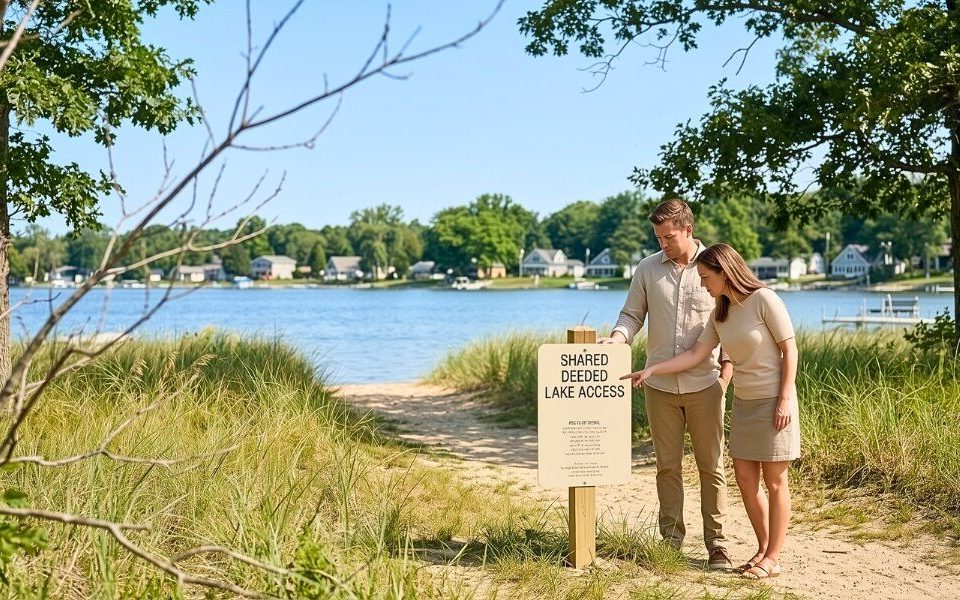
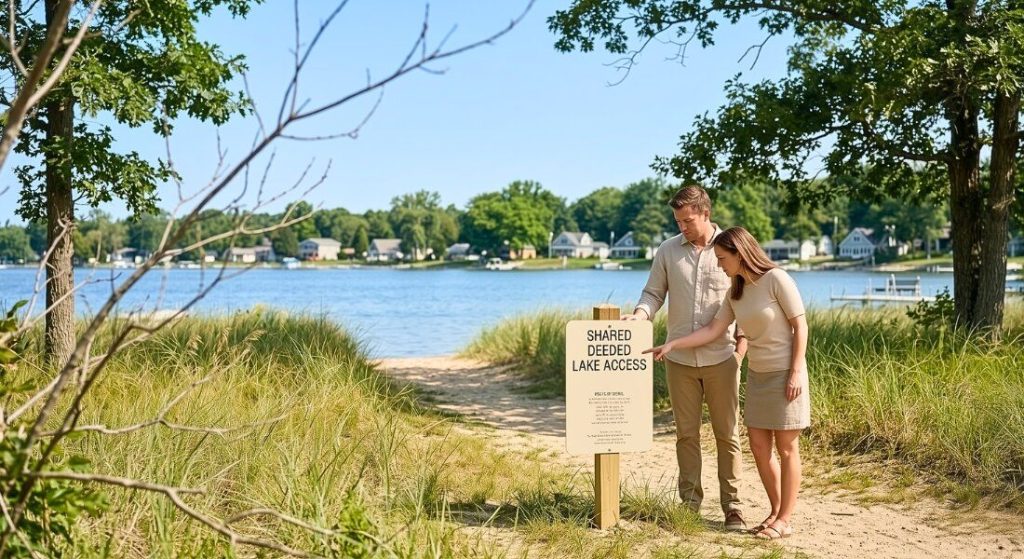
On a 40-foot lot, your neighbors are close. With a shared dock, they are co-owners of a resource. There’s no association document to resolve conflicts because there is no HOA.
Before you finalize anything, talk to the neighbors. Not just for friendliness, but to do it as research.
- Ask about past disputes over access, docks, or water use.
- Ask what the lake culture is like: quiet or lively, recreational or residential, seasonal or year-round.
- Ask if they know the history of the property’s septic system.
These conversations cost nothing. Skipping them can be expensive.
On Southwest Michigan lakes, the neighbor relationship is the main layer of governance. That’s not a flaw, it’s just how these communities work. Knowing this changes how you approach buying a lake property, and before the closing.
What Questions Should You Ask Before You Close?
Buying a Southwest Michigan lake property from a Chicago background requires a key adjustment. Forget what you know about HOA-governed communities and start asking different questions.
- Township Rules: Which township is the property in, and what ordinances govern water use on that lake? State law is online via the Michigan Legislature, but township rules require a call to the local office.
- Lake Association: Is it voluntary? What do dues fund? Does the budget include water-quality testing?
- Septic System: How old is it? When was it last serviced? Does the county require a time-of-sale inspection?
- Neighbors: Ask about dock placement and lake culture before you finalize anything.
The absence of a formal HOA isn’t a gap; it’s just a different structure than most Chicago buyers expect. Grasping these details before you close can be the difference between a smooth purchase and surprises.
FAQs About HOAs and Michigan Lakes
Do Michigan lake properties have HOAs?
Some lakes have homeowner associations, but most are informal and voluntary. Membership is optional, and dues are low (about $100 per year). Activities usually focus on community events or basic water-quality testing. These associations generally cannot enforce rules about how you use your property.
Which rules govern lake property in Southwest Michigan?
The binding rules come from township ordinances and Michigan’s riparian law, not from HOAs. They cover boating hours, dock and seawall permits, right-of-way access, and water use. Rules vary by township, so research the specific lake’s township, not just the county.
Can an HOA tell me how to use my dock or boat?
Usually not. Most lake associations have no authority over dock setup, boat use, or shoreline plantings. Any restrictions come from township ordinances or Michigan riparian law, not the HOA.
What is riparian law, and why does it matter?
Riparian rights define how landowners who share a water boundary can use the lake. They cover access, dock placement, and water use. Knowing these rights and how they interact with township rules is far more important for property use than any HOA document.
How does septic affect a lake property purchase?
Many lake homes rely on septic systems instead of municipal sewer. Ask about the system’s age, last service, and whether it fits the home’s bedroom count. Replacement can cost $10,000–$20,000 or more. Skipping inspection on an older system carries real financial risk.
Does the lake association test the water, and should I rely on that?
Some associations test water quality as part of their dues. It provides a general view of the lake’s health, but it doesn’t assess your property’s septic system. Treat association testing as supplemental information, not a substitute for a property-level inspection.
Why do rules vary so much from lake to lake?
Township governments set their own water-use ordinances. They are the primary authority, not the county or any HOA. Two lakes just a few miles apart can have completely different rules.
Buying Into a Southwest Michigan Lake Community
The absence of a formal HOA is not a problem to solve. It is a different structure than what Chicago buyers are used to. Once you understand where the real rules come from, the picture gets clearer.
Are you weighing a lake purchase in Southwest Michigan? The Michigan Lakes Team can provide a clear read on what you are actually buying into. Reach out now to start a conversation.
Michelle Scott is the founder of Michigan Lakes Real Estate Team Inc. at Michigan Lakes Real Estate Team Inc.. A licensed broker in both Michigan and Indiana since 1995, she has closed over $35.5 million in tracked waterfront volume and is recognized as a top waterfront specialist in Southwest Michigan.
ABOUT THE AUTHOR
Michelle Scott | Multi-Million-Dollar Producer | Owner, Michigan Lakes Real Estate Team Inc. | Licensed Realtor® since 1995 | Waterfront Specialist across 120+ Southwest Michigan lakes | Licensed in Michigan and Indiana