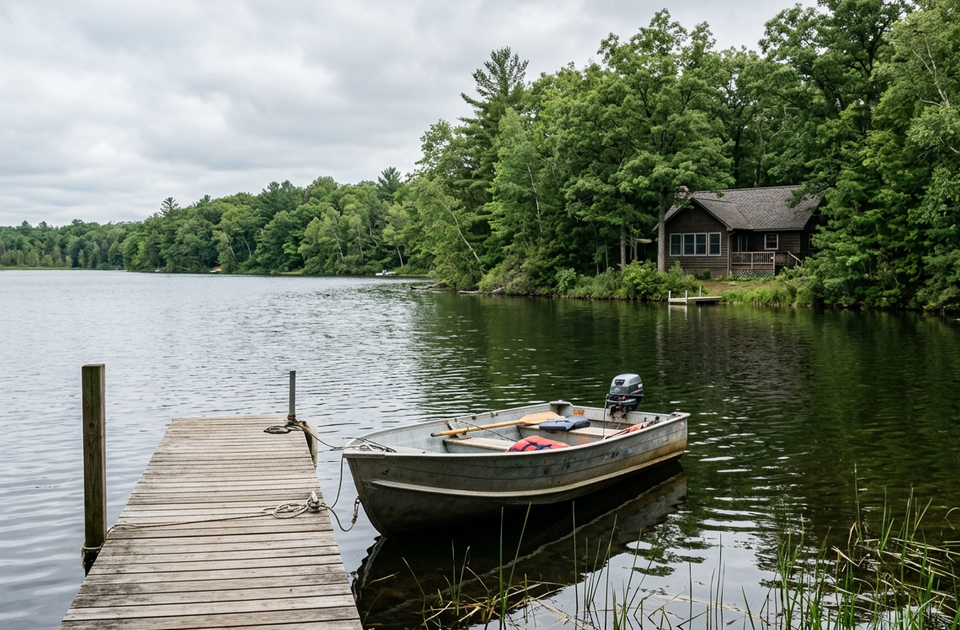

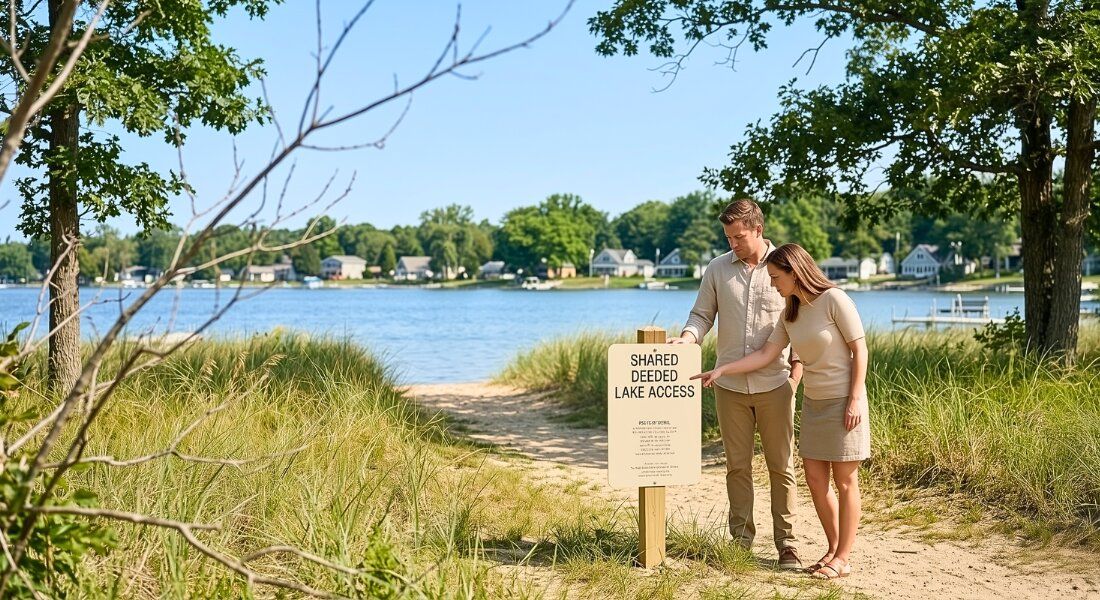
Deeded lake access in Southwest Michigan does not automatically mean a dock. It does not mean a boat slip. It does not mean the right to leave anything in the water.
Buyers who skip this distinction before making an offer frequently discover it after closing. By then, the answers cost far more than the question would have.
This is one of the most common misreadings of lake property purchases in Southwest Michigan. It costs buyers negotiating leverage and creates disputes with neighbors they have never met. Occasionally, it leaves a buyer without a place to moor the boat they purchased the property for.
This post covers what you need to know about lake access and what to ask before you write an offer.
Deeded lake access in Michigan provides a legal right to reach the water through a strip of land but does not automatically include dock rights or the ability to moor boats. The type of access, whether egress-only or pier-rights, along with how many properties share the access strip, determines what activities are actually permitted and should be verified in the deed before making an offer. Shared piers require agreement among all co-owners for major decisions, and riparian laws limit how dock placement and expansion can affect neighboring properties.
What Deeded Lake Access Permits in Michigan
Deeded lake access is a legal right to reach the water. It comes through a strip of land, typically 15 to 25 feet wide, that appears in the property deed. It gives you a path to the water. That is not the same as owning the shoreline.
Two distinct access types appear in these deeds:
- Egress access means you can walk to the water, and someone can pick you up by boat. You cannot leave anything there.
- Pier-rights access permits a shared dock. However, the terms depend entirely on the deed language and how many other properties share that same strip.
Buyers often do not ask which type they are getting. The listing rarely clarifies.
That distinction determines whether the property works for how you plan to use the water. Understand it before you negotiate the price, not after.
Buyers Should Think About Shared Piers
When deeded access includes pier rights, those rights are almost always shared. The same 15-foot strip might serve five different properties. That means five potential boat slips on a single pier. Every major decision about that pier requires agreement among all five owners.
I have worked in Southwest Michigan lake markets since 2003. The complications on shared-access properties come up consistently enough that I address them directly before a buyer writes an offer.
“They need to know what kind of access it is. Is it egress? Can they put a pier there? How many people share the pier? It could be that there are five houses that have deeded access and they all use the pier. You need a longer pier if you have more than one boat. And who pays for that, and who gets to use it? You don’t want a neighbor who’s not kind. You need to find a way to get along.” – Michelle Scott, Broker and Owner
One buyer I worked with assumed they had full control over docking. The deed permitted shared use, not individual control. They eventually negotiated an additional 10 feet of pier with the other four access owners.
It worked out. But the buyer was not expecting to need that conversation before they could use the water.
Condos Can Add Another Layer of Considerations
Condominium developments with lakefrontage typically include shared deeded access to a common dock and beach. That access might span 200 or 300 feet and serve every unit in the development.
What comes with it is shared docking, shared beach, and shared rules. All of it is in the association’s governing documents. How many boats can dock, who gets priority, and what is permitted for personal watercraft will be spelled out there.
Buyers need to read those documents before forming any picture of how their time on the water works. The governing documents are not fine print. They are the product. The Michigan Condominium Act governs what associations must disclose.
What Riparian Rights Control and Where They Run Out
Riparian rights govern what a waterfront owner can do at and in the water. They are not unlimited. Michigan riparian law, as interpreted by state courts, holds that one owner’s use cannot unreasonably interfere with a neighboring owner’s rights.
Two situations come up repeatedly:
- The first is narrow lots. On a 40-foot-wide waterfront lot, the dock placement must account for the neighbor’s dock. On a curved bay, every dock must coexist within the same navigable space.
- The second is dock expansion after closing. If you want to add sections, install a boat hoist, or reconfigure your setup, you need a permit. That means going to the Michigan Department of Environment, Great Lakes, and Energy.
I have seen this play out on a narrow lot where a neighbor’s large boat was encroaching on a buyer’s riparian space. I encouraged the buyer to address it directly before going further in the transaction.
“Someone’s buying a property in the winter, and the dock isn’t in already. They don’t know what they’re getting into. If you’re on a bay, you can imagine how the docks all go to a point, and that can be a problem with your neighbors, especially on a 40-foot lot. You’re close. You’re out on your deck, and you can practically hold hands with the next house. You have to get along with your neighbors and have the same respect for each other.” – Michelle Scott, Broker and Owner
Check out our article on how frontage drives lakefront value. It covers how frontage and lot width can impact a property. We also go over the pricing mechanics in detail.
Not sure what a listing’s deeded lake access actually entitles you to? Talk to the Michigan Lakes Team before you make an offer. Understanding the access structure first gives you real negotiating leverage.
The Questions to Ask Before You Write an Offer
Listings often say things like “lake access” or “deeded lake access.” If it’s anything that stops short of “waterfront” or “on the lake”, the access arrangement needs to be understood before you negotiate the price.
The value of that property depends on what the access permits. It also depends on whether the conditions attached to it work for how you plan to use the water.
Ask these questions before you write an offer:
- Is this egress-only, or does it include pier rights?
- How many properties share the access strip?
- What do the governing documents say about boats, personal watercraft, and overnight mooring?
- Is there a history of disputes among access owners, and if so, what happened?
These are not complicated questions. However, many buyers do not realize they should ask them.
It is also worth reviewing what to watch for in a lake home inspection. Access rights and physical condition are the two areas where buyer assumptions most often diverge from reality.
FAQs About Michigan Lake Access
What is the difference between deeded lake access and owning waterfront property?
Waterfront ownership means the property boundary extends to the water’s edge. You have direct control over your frontage and riparian rights. Deeded lake access gives you a legal right to reach the water through a separate strip of land. You do not own the shoreline itself.
Can I put a dock on a deeded lake access property in Michigan?
Not automatically. Some deeded access arrangements permit a shared pier. Others are egress-only, meaning you can reach the water but cannot install or moor anything there. Review the specific deed language before assuming dock rights exist.
How many properties typically share a deeded lake access strip?
It varies. Some strips serve two or three properties. Others serve five or more. In older Southwest Michigan lake developments, a single 15-foot access parcel can have multiple homes attached to it.
What happens if co-owners of a shared pier disagree?
Shared pier arrangements often lack formal governance documents. Disputes get resolved through negotiation among co-owners, or not at all. Before purchasing a shared-access property, understand who else shares the pier and whether there is any history of conflict.
What should I look for in condo association documents before buying a lakefront condo?
Look for the rules governing dock use, how many slips are available, how they are assigned, and whether there is a waitlist. Review what is permitted for boat size and personal watercraft. Also, check the rules for beach access, guest use, and seasonal storage.
Does dock placement matter even if I own waterfront property outright?
Yes. Michigan riparian law requires that your dock not unreasonably interfere with your neighbors’ access and use of the water. On narrow lots or curved bays, dock placement can become a real source of conflict. Before purchasing a narrow waterfront lot, understand where the neighboring docks sit and whether the configuration leaves you workable space.
Can I add onto a dock after closing?
Any modification that extends into the water requires a permit from EGLE. You might also need one from the local township. You also need to ensure any addition stays within your riparian boundary. If you are planning major dock configurations, understand the permit requirements and neighbor considerations before closing, not after.
What the Listing Says and What You Are Actually Buying
Access language in a listing tells you that some form of access exists. It does not tell you whether that access supports your planned use of the water. That takes more than a line in a listing description to evaluate.
Michigan Lakes Team works exclusively with lake home buyers in Southwest Michigan. That focus means we have seen the same deeded-lake-access situations play out enough times to know which questions to ask. And when the answers should change your offer.
If you are evaluating a property with any form of lake access, start a conversation with us today. We can get the information you need to move forward with confidence.
Michelle Scott is the founder of Michigan Lakes Real Estate Team Inc. at Michigan Lakes Real Estate Team Inc. She is a licensed real estate broker in both Michigan and Indiana, has been licensed since 1995, and has closed over $35.5 million in tracked volume with an exclusive focus on waterfront and vacation properties across Southwest Michigan.
ABOUT THE AUTHOR
Michelle Scott | Multi-Million-Dollar Producer | Owner, Michigan Lakes Real Estate Team Inc. | Licensed Realtor® since 1995 | Waterfront Specialist across 120+ Southwest Michigan lakes | Licensed in Michigan and Indiana