
Most buyers looking at lakefront condos in Michigan assume they are buying access to a lake. They are. What the listing rarely explains is how that access works.
Show up on a Saturday in July with two boats and a jet ski, and the picture often looks different from what it did at the showing.
Shared lake access in a Michigan condo community is real, deeded, and legally binding. It is also shared among every unit owner in the association.
The details of how that access works, who shares it, what you can dock, and how disputes get resolved live in the condo association documents. Not in the listing description.
Shared lake access in Michigan condo communities means all unit owners collectively use a common shoreline, dock, and beach governed by association rules, not individual waterfront ownership. The number of boats you can dock, whether personal watercraft are allowed, and how dock modifications get approved are determined entirely by the condo association documents, which buyers must review before making an offer. Without understanding these restrictions in advance, buyers often discover after closing that their intended watercraft use conflicts with limited dock space and neighbor approval requirements.
What “Lake Access” Means in a Condo Community
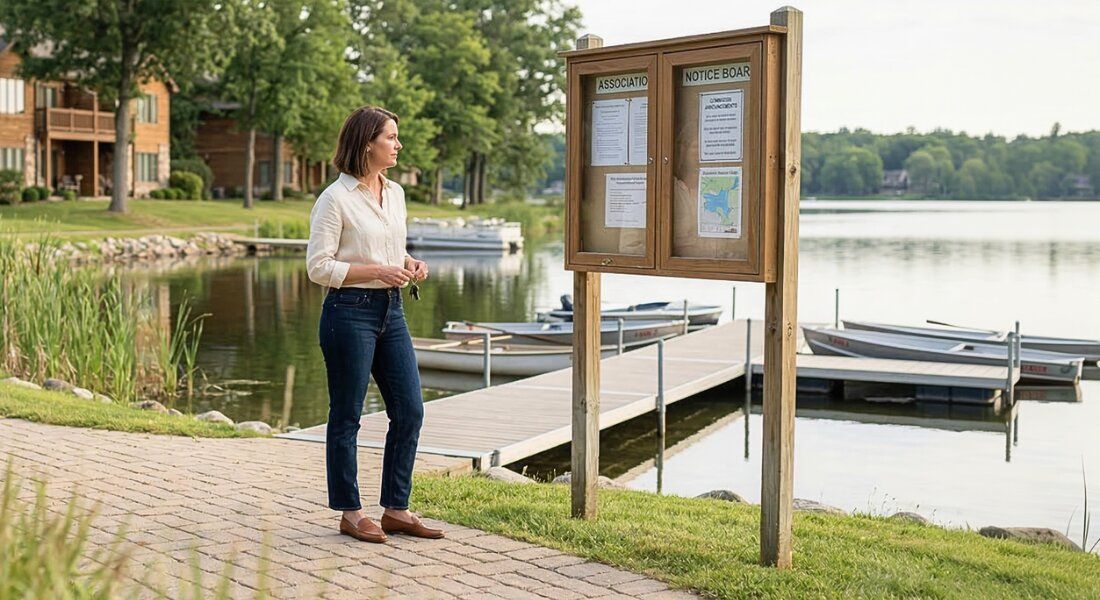
When a condo development sits on or near a lake, the association typically holds a shared access corridor. Sometimes that stretch of shoreline runs 200 to 300 feet wide. All unit owners use it collectively.
That means they all share the beach, the dock, and the launch area. Every slip, every parking spot for watercraft, every square foot of shoreline is a community resource governed by association rules.
That is not a red flag on its own. Plenty of buyers find this arrangement works well. The problem comes when buyers arrive at closing expecting something closer to individual waterfront ownership.
Under Michigan’s Condominium Act, condo associations hold the authority to set and enforce rules governing shared amenities. That includes waterfront access.
Those rules appear in the master deed, bylaws, and association rules. Three separate documents. Each carries a different weight. Rarely handed to a buyer during a showing.
The Dock Math Nobody Does Before Closing
Here is where the gap becomes concrete.
If five or six units share a single dock, that dock has to be long enough to accommodate everyone who wants to use it. Who pays for extensions? Who decides whether one owner can add a slip? What happens when one unit wants a boat lift and another objects?
These questions get answered in the association rules. Or, in associations that have not planned well, they get answered in arguments between neighbors.
I have spent more than two decades working exclusively in waterfront and vacation properties across Southwest Michigan. I have watched this assumption create friction for buyers. It’s often the result of them doing their research everywhere except in the documents governing the one thing they were actually buying.
“Any lake that has condos on it, they will be given deed access. It’s usually a big area, maybe two to three hundred feet across, and everybody shares that in the condo. So if you have six condos, know that you’re going to share the docks and you’re going to share the beach and you’re going to share everything. You have to be aware of that.” – Michelle Scott, Broker and Owner
Buyers who have not read the association documents before making an offer are working from assumptions. The reality depends entirely on what the documents say. And on the other people sharing that dock.
What the Condo Association Documents Cover
Before a buyer gets emotionally committed to a condo lake property, the association documents deserve the same attention as the inspection report.
The Michigan Department of Licensing and Regulatory Affairs (LARA) requires that sellers provide condo documents to buyers. That disclosure obligation does not mean buyers always read them carefully before going under contract.
Read specifically for:
- The number of boats each unit may dock
- Whether personal watercraft carry separate rules or storage requirements
- How dock additions or modifications get approved
- What the cost-sharing arrangement looks like for dock maintenance and expansion
- Whether the documents define a process for resolving disputes between unit owners over access or space
Some associations have this sorted: clear rules, reasonable limits, and a functional governance structure. Others are looser. The buyer discovers what that means the first summer they show up with equipment that doesn’t fit the space they imagined.
The access is real. Whether it works for how you intend to use it is a different question.
If you are uncertain what to look for in condo documents before making an offer, start a conversation with the Michigan Lakes Team before you write the offer.
Why the Showing Doesn’t Reveal Any of This
Showings happen at the unit. The agent walks you through the kitchen, the bedrooms, and the view from the deck. If the dock is in and the lake is visible, the picture feels complete.
What a showing rarely includes is a review of the association documents with someone who can explain those rules. Without that, the buyer might get an unrealistic picture of what they are buying into.
I have seen what happens when buyers skip this step.
“Someone believed that they had more control over how many boats and jet skis they could dock, but it has to be agreed by everybody. Sometimes you get one boat space and nothing else. They thought they could put as many boats and jet skis as they wanted, and that just wasn’t the case. So they had to purchase more pier and get it approved by the other five owners, and they weren’t anticipating that.” – Michelle Scott, Broker and Owner
That story ends reasonably well. The buyer negotiated an additional ten feet of pier and made it work. But the negotiation happened after closing, with people they had not yet met, over something they had not planned for. This is not the position any buyer should be in.
Read our post about how wake rules affect buyer fit on Southwest Michigan lakes. It provides a broader look at how waterfront rules shape the daily rhythm of lake ownership.
How Shared Dock Rights Get Allocated Among Unit Owners
The association governs dock allocation either through the documents themselves or by board vote. In small associations with few units, decisions often require unanimous or near-unanimous agreement.
That means a buyer’s plans for additional dock space, a boat lift, or expanded storage may depend on the cooperation of neighbors they have not yet met.
Buyers with jet skis may face specific complications. Many Michigan lake condo associations have separate provisions for personal watercraft. Restrictions on storage, launch timing, or whether they are permitted at the shared dock at all. Boat access does not automatically extend to all watercraft.
This is worth confirming before the offer, not after. Understanding how frontage and access rights drive lakefront value gives additional context for why these document details carry real financial weight.
FAQs About Condos and Lake Access in Southwest Michigan
What does shared lake access mean in a Michigan condo community?
Shared lake access means the condo association holds a legal right to use a portion of the shoreline, and that right passes to each unit owner. It is real access, not a courtesy. But in a condo setting, deeded access is almost always shared among all unit owners.
How many boats can I dock at a lakefront condo in Michigan?
That depends entirely on the association’s rules. Some associations allow one boat per unit. Others allocate slips based on dock capacity or seniority. Personal watercraft often fall under separate rules. The only way to know is to read the governing documents before making an offer.
Can I add a dock slip or extend the pier at a condo lake property?
You’d typically need association approval. Dock modifications may require a board vote. In smaller associations, that may mean agreement from every unit owner. Some documents prohibit modifications outright. Confirm what the rules allow before assuming you can expand access after closing.
What sections of the condo documents matter most for lake access?
Focus on dock access and watercraft limits, shared amenity rules, and cost-sharing for dock maintenance. Also, review the process for approving modifications and dispute resolution procedures between unit owners. These sections tell you what your access actually looks like in practice.
Is shared lake access a problem, or can it work well?
It can work well. Many condo buyers are satisfied with shared access, particularly in well-run associations with clear rules and enough dock space. The issue is not shared access itself. It’s buying without understanding the terms.
What happens if association rules are unclear or the association is poorly managed?
Ambiguous rules tend to be resolved through neighbor-to-neighbor disagreement rather than through clear policy. In small associations, one difficult owner can complicate access for everyone.
Who decides how dock space gets allocated in a Michigan lake condo?
The association governs that allocation either through the documents or by board vote. In small associations, decisions often require unanimous or near-unanimous agreement. A buyer’s plans for additional dock space or expanded storage may depend on the cooperation of neighbors they have not yet met.
Before You Make an Offer on a Condo Lake Property
Lake access in these condo communities is real, but it always comes with structure and limits. Confirm those limits early so your expectations match the reality on the water.
The Michigan Lakes Team works with buyers to evaluate condo lake access before decisions get locked in. Reach out to talk through the details so you can move forward with clarity.
Michelle Scott is the founder of Michigan Lakes Real Estate Team Inc. at Michigan Lakes Real Estate Team Inc. She has been a licensed real estate broker in Michigan and Indiana since 1995, working exclusively in waterfront and vacation properties across Southwest Michigan. She is a multi-million-dollar producer and Top Waterfront Specialist in Southwest Michigan.
ABOUT THE AUTHOR
Michelle Scott | Multi-Million-Dollar Producer | Owner, Michigan Lakes Real Estate Team Inc. | Licensed Realtor® since 1995 | Waterfront Specialist across 120+ Southwest Michigan lakes | Licensed in Michigan and Indiana